
Blog
Quick answer: The best material for outdoor business signs in Sydney depends on where the sign is installed and how long it needs to last. For permanent signs, 316 stainless steel and powder-coated aluminium are the most durable, especially near the coast. ACM and UV-stabilised acrylic suit most shopfronts and 3D lettering, while Corflute and foam PVC are best for temporary signs.
What Sydney's Climate Does to Outdoor Signs
Sydney presents a particularly varied environment for outdoor signage. Its geography stretches from coastal suburbs exposed to salt-laden air to Western Sydney, where temperatures can reach extreme levels. Add high UV exposure for much of the year, and signs installed across the city can face very different forms of weathering.
UV: The Biggest Threat to Any Sydney Sign
Long-term UV exposure can lead to:
- Colour fading
- Print deterioration
- Plastic degradation
- Finish breakdown
UV exposure is not limited to Sydney's summer, and its effects on outdoor materials accumulate over time. UV radiation can degrade polymers used in plastics, coatings and adhesives, while prolonged exposure can also affect pigments and printed finishes.
For long-term signage, choosing a UV resistant sign material in Australia is only part of the equation. Exterior-grade coatings and UV-resistant inks, laminates and adhesives can also help slow deterioration.
Salt Air Near the Coast
Marine exposure can contribute to:
- Surface corrosion
- Tea staining
- Fixing corrosion
- Finish damage
Salt deposits can accumulate on exposed signage components, increasing the risk of corrosion. This is why choosing the best signage material for coastal areas requires looking beyond the sign face itself.
The Australian Stainless Steel Development Association recommends 316 stainless steel, or an equivalent corrosion-resistant grade, as a minimum within 5 km of the surf. It also notes that lower grades, such as 304 and 430, are more susceptible to tea staining and corrosion in marine environments.
For coastal signage, 316 stainless steel, appropriately coated aluminium, and other corrosion-resistant materials are among the best options. Frames, brackets and fixings should also be specified for marine exposure, not just the visible sign face.
Heat and Thermal Movement in Western Sydney
Temperature changes can contribute to:
- Panel expansion
- Joint stress
- Fixing pressure
- Edge distortion
Sign materials expand as they heat and contract as they cool, but different materials expand and contract at different rates.
According to NIST reference data, acrylic has a typical thermal expansion coefficient of 68 × 10−6/°C, compared with 24 × 10−6/°C for aluminium. This means acrylic can experience nearly three times as much thermal movement for the same temperature change.
This difference becomes important for larger outdoor signage in Sydney, where even low rates of expansion can add up across the panel.
In hotter parts of Western Sydney, suitable clearances, mounting methods and fixing tolerances can help accommodate repeated expansion and contraction without placing unnecessary stress on the sign.
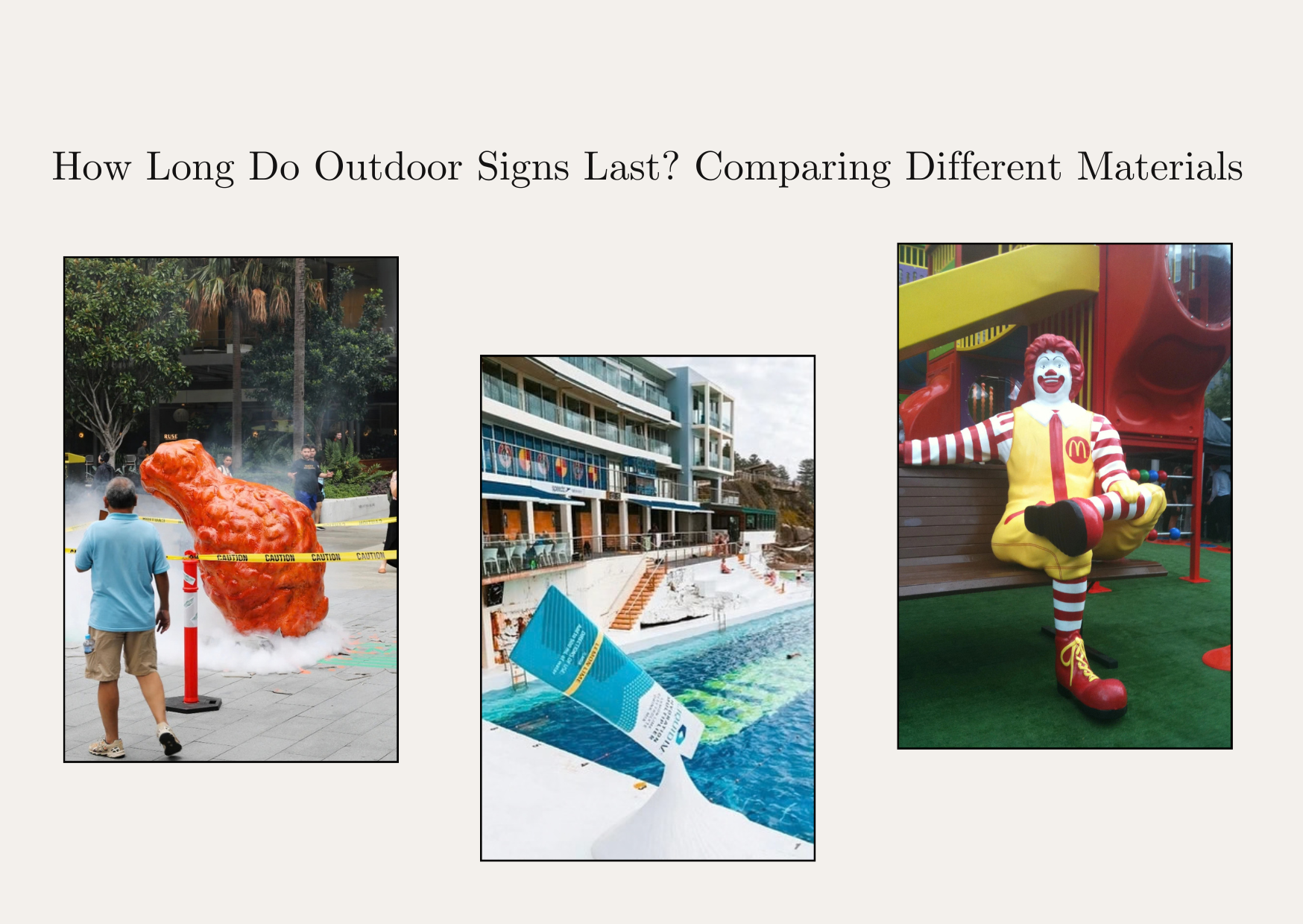
How Long Do Outdoor Signs Last? Comparing Different Materials
There is no single lifespan for an outdoor business sign. Depending on the material, finish, installation and level of exposure, some signs are designed for temporary use while others can remain serviceable outdoors for many years.
The comparison below looks at six common options and where each makes the most sense for outdoor signage in Sydney.
1. Aluminium Composite Panel (ACM)
Aluminium composite panel (ACM) signs consist of a lightweight core bonded between thin aluminium sheets, creating a rigid yet relatively lightweight panel for exterior signage.
Common uses include:
- Shopfront panels
- Building signs
- Directional signs
- Printed signboards
Key advantages include:
- Lightweight construction
- Good rigidity
- Weather resistance
- Smooth finish
Outdoor lifespan: Around 5–10+ years, depending on the panel grade, exterior finish, graphics and level of exposure.
2. UV-Stabilised Acrylic
UV-stabilised acrylic is commonly used when appearance, dimensional depth or light transmission is important in an outdoor sign.
Common uses include:
- 3D lettering
- Logo signs
- Sign faces
- Illuminated signs
Key advantages include:
- Clean finish
- High clarity
- Colour versatility
- Light transmission
Outdoor lifespan: Around 5–10+ years, depending on the acrylic grade, exposure, fabrication and maintenance.
3. Powder-Coated Aluminium
Powder-coated aluminium combines a lightweight, corrosion-resistant metal with a durable exterior finish, making it suitable for long-term outdoor signage.
Common uses include:
- Fabricated letters
- Building signs
- Sign frames
- Sign panels
Key advantages include:
- Corrosion resistance
- Durable finish
- Low maintenance
- Colour flexibility
Outdoor lifespan: The Powder Coating Institute states that powder coatings can last 15–20 years in many environments, although longevity depends on the coating system, preparation and exposure conditions.
4. 316 Marine-Grade Stainless Steel
316 marine-grade stainless steel offers high corrosion resistance, making it particularly suitable for outdoor signage in Sydney, especially in coastal areas exposed to salt-laden air.
Common uses include:
- 3D lettering
- Logo signs
- Metal plaques
- Sign fixings
Key advantages include:
- High durability
- Corrosion resistance
- Premium finish
- Coastal suitability
Outdoor lifespan: The British Stainless Steel Association cites data indicating that 316 stainless steel can last several decades, including in marine environments.
5. Coated EPS Foam and HDU
Coated EPS foam and high-density urethane (HDU) are lightweight materials used to create dimensional outdoor signage without the weight of solid metal or acrylic.
Common uses include:
- 3D lettering
- Business logos
- Dimensional signs
- Decorative features
Key advantages include:
- Lightweight construction
- Custom shaping
- Greater depth
- Design flexibility
Outdoor lifespan: Coated EPS typically lasts around 5–10 years, while properly finished HDU can last around 10–20+ years, depending on exposure, coating and maintenance.
6. Foam PVC and Corflute
Foam PVC and Corflute are lightweight, economical materials better suited to temporary or short-term outdoor signage than to permanent installations.
Common uses include:
- Event signs
- Sale signs
- Site signage
- Promotional boards
Key advantages include:
- Low cost
- Lightweight design
- Easy printing
- Quick installation
Outdoor lifespan: Foam PVC typically lasts around 3–5 years outdoors, while Corflute is generally better suited to 6–24 months of outdoor use, depending on thickness, UV exposure, and weather conditions.
Here is how the expected outdoor lifespan of each signage material compares:
| Sign material | Typical outdoor lifespan | Best suited for |
|---|---|---|
| ACM | 5–10+ years | Shopfronts, panels, directional signs |
| UV-stabilised acrylic | 5–10+ years | 3D lettering, logos, illuminated signs |
| Powder-coated aluminium | 15–20 years | Building signs, lettering, frames |
| 316 stainless steel | Several decades | Premium and coastal signage |
| Coated EPS foam | 5–10 years | Lightweight dimensional signs |
| HDU | 10–20+ years | Long-term dimensional signage |
| Foam PVC | 3–5 years | Shorter-term outdoor signs |
| Corflute | 6–24 months | Temporary and promotional signs |
Disclaimer: These are general lifespan ranges rather than guarantees. UV exposure, coastal conditions, coatings, installation quality and maintenance can all affect how long an outdoor sign lasts.
Best Signage Material for Coastal Areas vs Inland Sydney
Location can quickly narrow down the most suitable materials for an outdoor sign.
For coastal Sydney:
- 316 stainless steel – exposed metalwork
- Powder-coated aluminium – frames and lettering
- Exterior-grade ACM – sign panels
- UV-stabilised acrylic – illuminated elements
The best signage material for coastal areas depends on the sign design, but corrosion-resistant materials and properly specified hardware should take priority.
For inland Sydney:
- ACM – sign panels
- Acrylic – 3D lettering
- Powder-coated aluminium – fabricated signs
- HDU – dimensional signage
There is no need to choose one material for the entire sign. A business sign can combine ACM panels, acrylic lettering and aluminium framing, allowing each material to be used where its properties are most useful.
Which Materials Should You Avoid for Permanent Outdoor Signs?
Not every sign material is designed for years of continuous outdoor exposure. Some options are better reserved for temporary or protected applications.
| Material | Why it may not suit permanent outdoor use | Better suited for |
|---|---|---|
| Corflute | Short outdoor lifespan | Events and temporary signs |
| Foam PVC | Limited long-term durability | Short-term displays |
| Untreated timber | Vulnerable to moisture and weathering | Protected locations |
| Indoor-grade acrylic | Limited UV resistance | Indoor signage |
| Uncoated EPS | Vulnerable to UV and weather | Coated dimensional signs |
| Low-grade metals | Greater corrosion risk | Indoor or protected areas |
The key distinction is “not suitable for permanent use” rather than “bad material.” Corflute, for example, can be ideal for temporary promotions, while coated EPS can work for dimensional signage. The material simply needs to match the sign's expected lifespan and exposure.
Choose Mega 3D Signs for Outdoor Signage in Sydney
The best material for outdoor business signs depends on the location, expected lifespan, design and level of exposure. From ACM and acrylic to powder-coated aluminium and stainless steel, each material has situations where it performs best.
At Mega 3D Signs, we design, manufacture and install outdoor signage in Sydney, helping businesses select materials and finishes suited to their project and environment. Our custom approach also allows different materials and finishes to be combined where the design calls for it.
Whether you need a new shopfront sign or a large outdoor installation, we can help take the project from initial design through to production and installation.
Contact our team today to discuss your signage requirements.
Frequently Asked Questions
Can you create custom outdoor signage?
Yes. At Mega 3D Signs, we create custom outdoor signage in Sydney tailored to your business, location, and design requirements. Our services cover the process from concept and design through to fabrication and installation.
How long does it take to create a custom outdoor sign?
Production time depends on the size, materials and complexity of the sign. Simpler signage may take a few days, while larger or more detailed 3D signage projects can take several weeks to design, fabricate and finish.
Do outdoor business signs need council approval in Sydney?
Some outdoor signs may require council approval or permits, depending on their size, location, illumination and installation. Requirements can also vary between local council areas, so they should be checked before fabrication or installation begins.
Can different materials be used in the same outdoor sign?
Yes. Outdoor signs can combine materials such as ACM, acrylic, aluminium and stainless steel to suit different structural, visual and durability requirements.
Can you help me choose the right material for my outdoor sign?
Yes. At Mega 3D Signs, we can recommend suitable materials based on the sign's location, size, design, expected lifespan and exposure to local conditions.